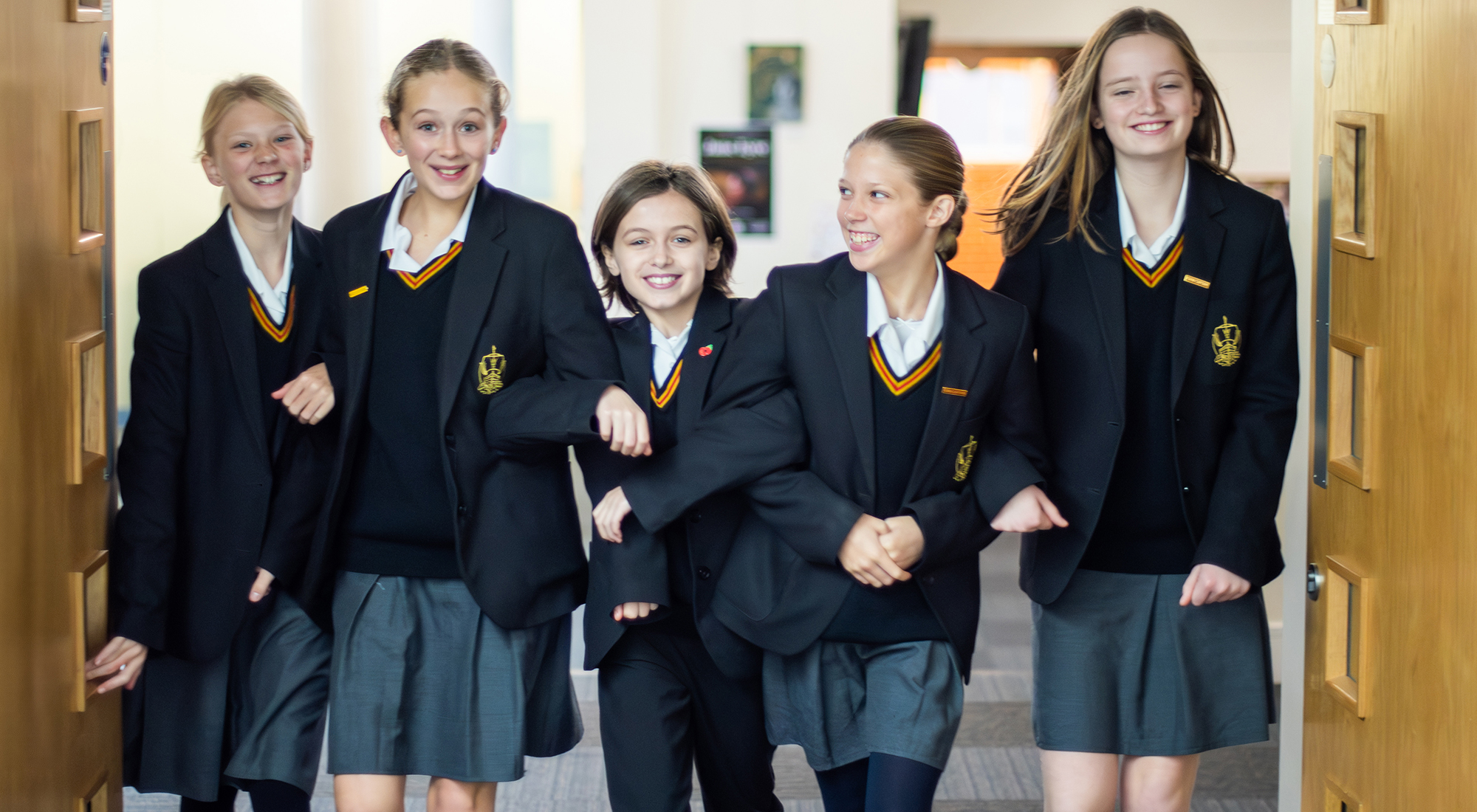
Hannah Couch, Head of Key Stage 3 and Polly Evernden, Deputy Head (Academic) at Walthamstow Hall are two important women at their school – one leading the academics, the other the pastoral care. Together they explain how Walthamstow Hall prepares girls not just to achieve, but to thrive, through a philosophy that wellbeing and academic excellence are not in tension, but in fact, one is the engine of the other.
Can you tell us about the opportunities for students in your Senior School?
Hannah: From the very first day, we want every girl to find her place, and we mean that literally. During their initial induction in Year 7, students choose which of our (more than 60) co-curricular clubs they’d like to join at our Co-Cu Fair, are introduced to their peer mentors who throw them a pyjama party, and go on a bushcraft camping trip – all designed to build friendships and a sense of belonging before the first lesson has even begun. It sounds fun, because it is, but it’s also intentional. A girl who feels she belongs is a girl who will be confident enough to take academic risks.
Polly: And these mitigated ‘risks’ start early! From Year 8 onwards, girls can begin to carve their own academic path, choosing a bespoke combination of subjects that challenge them without closing doors to future opportunities. The curriculum itself is genuinely broad, and academics never replace the arts – it’s more a symbiotic relationship that develops. Involvement in the arts has been proven to be beneficial to positive wellbeing, so we don’t make our girls choose one or the other. From Latin to Textiles, and from the mock bar trial to lacrosse matches – there is a place for every kind of learner. We want them to explore, try things, even fail at things, and try again. Perseverance is a skill we teach deliberately.
What Leadership Opportunities are available at your school?
Hannah: Leadership isn’t reserved for a chosen few. Girls nominate themselves for leadership roles – we have our Student Librarians in Year 7, girls choosing to take our Sports Leadership course in Year 9, and our Head Girl Team attends a weekly Senior Leadership Team meeting to share student concerns, which means student voices shape real decisions. Anyone can bring an idea forward and know it will be heard. That sense of agency is powerful. Girls here are not afraid to take up space and that confidence carries through into their futures. Research consistently shows that girls who attend all-girls schools are over-represented in traditionally male-dominated careers like STEM and finance, and we see why.
How do you celebrate non-academic achievements?
Polly: Every year, students in each form are peer-nominated for Values Awards – one for each of our school values: Respect, Integrity, Aspiration, Community, and Individuality. These aren’t handed out by teachers but from classmates. That tells you something about the culture. Girls are genuinely invested in each other’s success. Handing out these awards at the same time as celebrating academic successes is a perfect example how the two work hand-in-hand.
With exams upon us, what are your recommendations for those feeling the pressure?
Hannah: The first thing I’d say to any parent is: reframe what exams are. We talk to our girls about exams not as a threat but as an opportunity – a chance to put your best self forward. That shift in language matters more than you’d think. Exams and stress don’t have to go hand in hand.
Polly: Practically speaking, we teach study skills proactively and by age-group, so girls aren’t discovering revision strategies for the first time when GCSEs are looming. We talk to them, and to their parents, about the importance of routine over willpower. Habit is so much more sustainable than a last-minute push. We encourage short blocks of active revision in different formats: mind-mapping, flashcards, retrieval practice, past papers. Variety keeps the brain engaged.
Hannah: Sleep and balance are non-negotiable. We tell girls to schedule time for the things they enjoy alongside revision – not as a reward, but as part of the plan. A walk outside, time with friends, a creative activity. The brain consolidates learning during rest, so stepping away isn’t a luxury; it’s part of the process.
Polly: We also work hard to ensure that when exam season arrives, it doesn’t feel like it’s come out of nowhere. The hard work students put in across the year – the quality of class discussion, the feedback on essays, the habits of mind they’ve built – that’s all still there in the exam room. Exams are the culmination of everything that’s come before, not an isolated ordeal. Girls who understand that tend to walk in feeling prepared rather than panicked.
How do staff balance academic rigour with safeguarding students’ mental health and resilience in a high-achieving school environment?
Hannah: I’m not sure I’d agree that these are things to be ‘balanced’ – as if more of one means less of the other. In our experience, the opposite is true. A girl who feels known, supported, and safe is a girl who is willing to attempt the hard question, stand on stage, challenge herself academically, and keep going when something doesn’t click first time. Wellbeing is the foundation of academic success, not its rival. Our approach is proactive rather than reactive. We don’t wait for problems to arise and then address them – we try to give girls the emotional toolkit they need before they need it. From Year 7, we teach students how to initiate difficult conversations, navigate relationships in a healthy way, advocate for themselves, and set appropriate boundaries. These aren’t soft skills; they’re life skills, and they make girls more resilient, not less.
How do your students so consistently rise to high expectations?
Polly: There’s a psychological concept called the Pygmalion effect – the idea that high expectations, consistently communicated, become a self-fulfilling prophecy. We hold high expectations of every girl, but crucially, the girls internalise those expectations and hold them for themselves. They are not motivated to succeed in order to please us. They are motivated by their own success. That internal drive is far more powerful and far more durable than external pressure.
Hannah: Practically, every member of staff knows every girl – not just the high-fliers or those who need extra support, but everyone. Individual context is shared across the staff team. And we are explicit with students that the entire school community is cheering for them. We set the bar high, but we put scaffolding in place at every stage. No one is left to figure it out alone.
Polly: The results speak for themselves – not just in exam grades, but in the kind of young women who leave us. Confident, curious, resilient, and genuinely kind to one another. That’s what a good education should look like.
You can find out more about the school at walthamstow-hall.co.uk
If you’d like to visit Walthamstow Hall, their next open day will be on September 26th and is ideal for those looking to enter in September ’27, ’28 or ’29. It will be a great opportunity for prospective parents and their daughters to explore the Sevenoaks school, with a talk from the Headmistress and a tour of the campus. Book at walthamstow-hall.co.uk/event/whole-school-open-morning
You may also like

University Challenge
Does the idea of helping your youngster with their university options feel a bit much? Here, Emily Pavey gives a few pointers Let’s be honest, my only qualification for giving my two penneth is that I’m mum to two boys...

Mind the Message
Former head teacher Mike Piercy explains how to communicate effectively with your child’s school without taking offence I was horrified to hear from my son that he’d been told off by an angry Mr X for having his shirt untucked....
Meet the Head
We enjoyed learning about the SEND education provided by West Heath School, from School Principal, Photini Bohacek Tell us about West Heath School and what makes it unique among SEND schools?West Heath School supports young people with a range of...