Jo Arnell explores the fascinating and hugely beneficial world of our garden insects
I love a bug, and am beginning to learn that they all have a role and a place, despite the fact that the main job for many of them is to eat our plants. I have also learned that a bug is an insect, but that not all insects are bugs. Insects are many and varied, but they all share certain characteristics – six legs, an external skeleton and a body segmented into head, thorax and abdomen, and usually have wings. They are such weird looking creatures, like mini aliens, and perhaps this is why some of us find them creepy. Looked at closely they are amazing, with interesting behaviours and complicated life cycles, and such an intimate connection with plants that flowers could not have evolved without them. They are also a vital part of the food chain – for birds, small mammals and – if not directly (yet!) for us too.
Admittedly some need discouraging, but there are natural control methods – and things we can do to attract in the beneficial insects – those that will pollinate our plants, feed the birds and some that will even help us manage the less benign. Every aphid you leave on a leaf is a snack for a baby blue tit.
Butterflies and bees
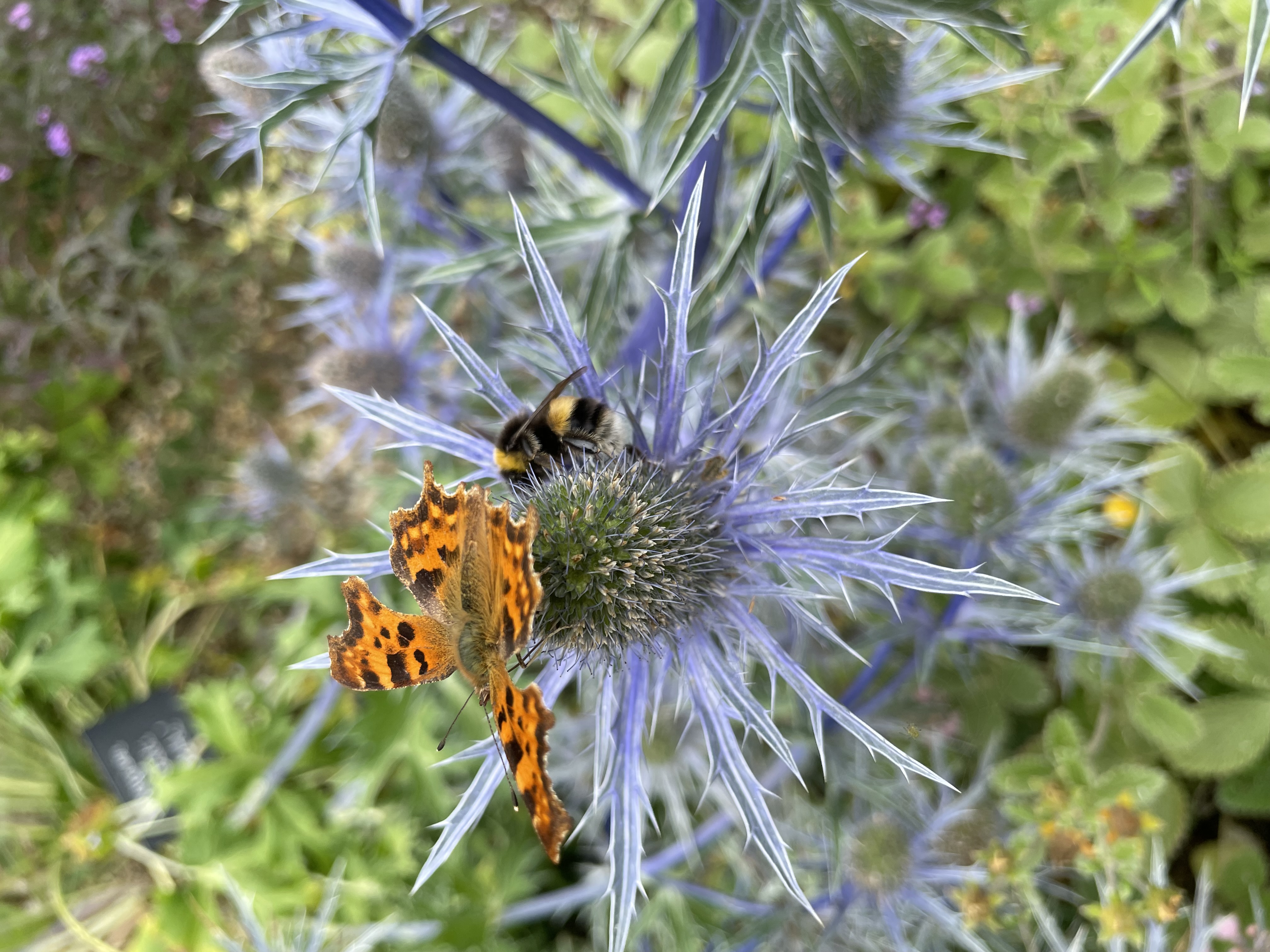
We love these attractive pollinators and if you grow the right plants they will visit. Butterflies are enticed into our gardens by brightly coloured flowers, while bumblebees love tubular blooms like foxgloves, penstemon and salvias. They all appreciate open, easy to access nectar sources that are found on plants like those in the daisy family or umbellifers like wild carrot, cow parsley and Ammi majus. Double flowers with lots of petals are less useful to them, as the nectaries are harder to access and in some cases are non-existent. Many highly bred cultivars are sterile and contain no nectar or pollen at all; they may be attractive to us, but not to the pollinators. Remember, too, that several of our native butterflies – the comma, small tortoiseshell, red admiral and peacock, need a patch of nettles for their caterpillars to eat and shelter in, and that the bees need nesting places in tucked away pockets that will stay undisturbed for the summer.
In the night garden
The poster pollinators are the butterflies and bees, and they tend to steal the limelight, because we see them when we’re in the garden, but there are some less visible, but just as important, just as beautiful and hard-working creatures out there busily collecting pollen and nectar through the night. Moths, beetles, lacewings and other night-flying insects appear from dusk onwards, as the brighter flower colours fade. White, pale mauves and blue shades then start to shine out into the twilight like tiny beacons. The bonus is that many of these flowers are also scented. Moths love plants like honeysuckle, nicotiana (tobacco plants) and evening primrose. Beetles are busier nearer the ground, some pollinating, others hunting slugs and grubs.
Let the right ones in
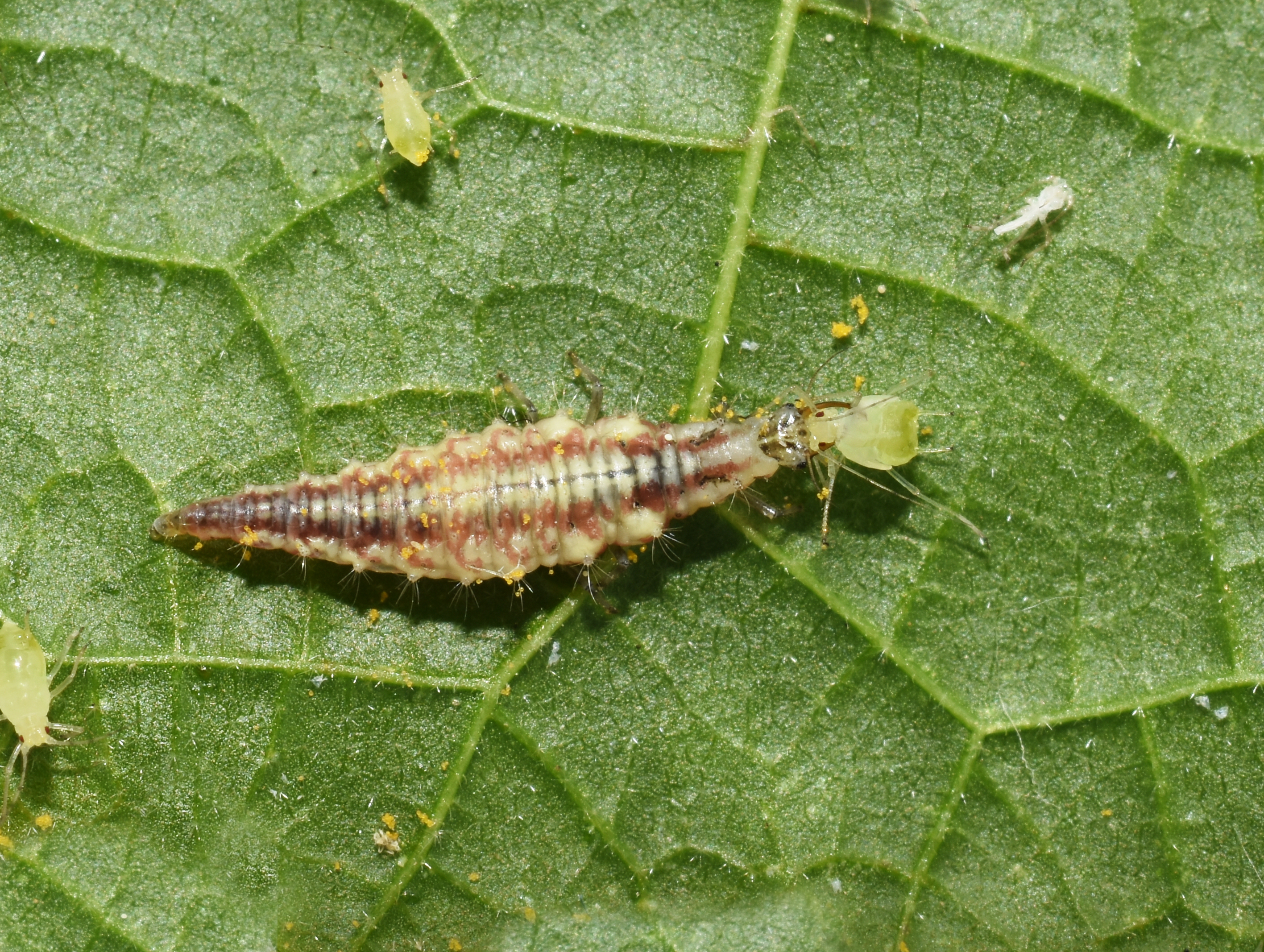
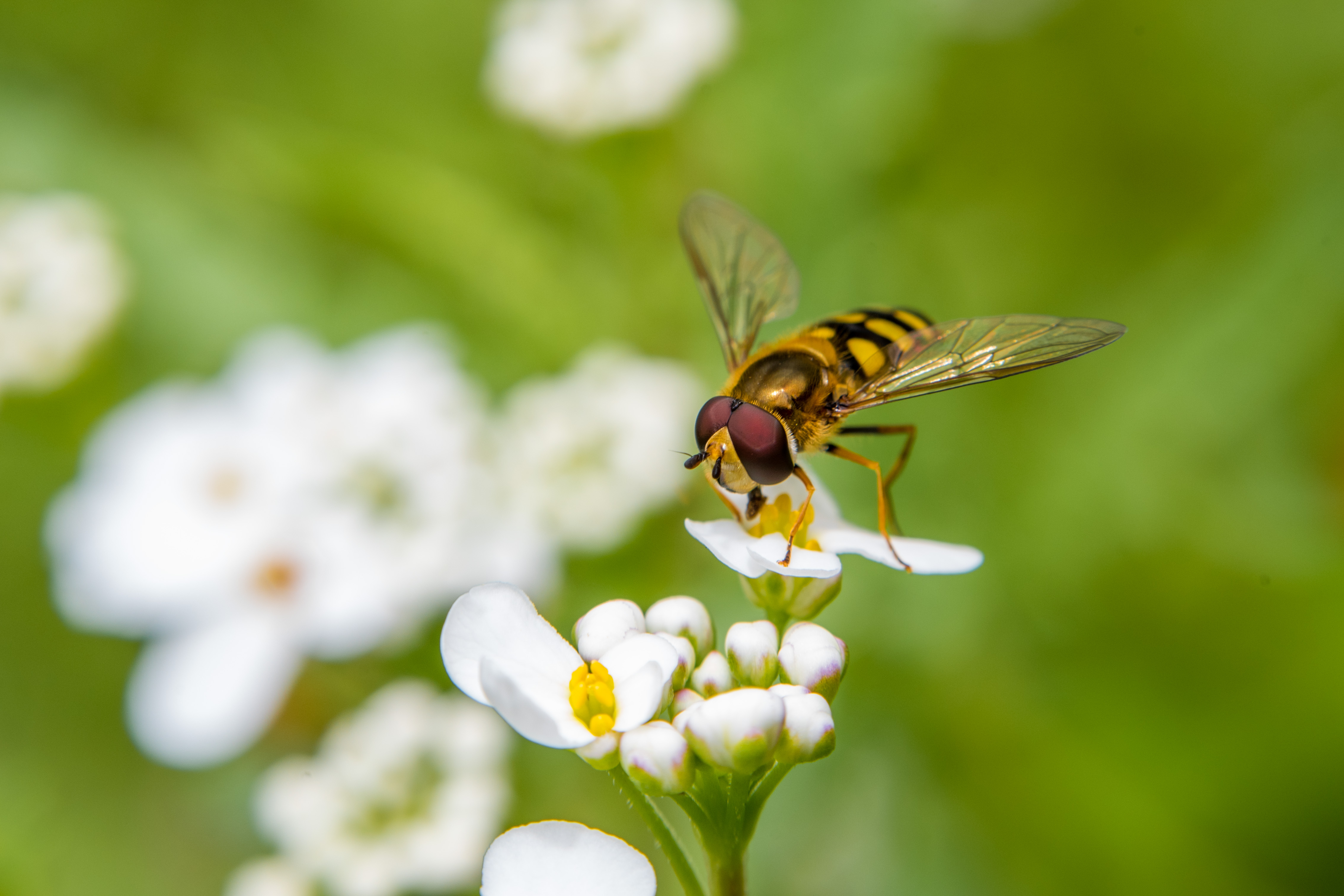
It is hard to discriminate between the good the bad and the ugly – it’s all subjective – and it can be tricky to understand that what looks like a pest may well be a predator of pests. Sometimes we see an insect on a leaf with holes in and imagine it is to blame – when perhaps it has just eaten the culprit and should be thanked – or at least spared from a squashing. Ladybird larvae look completely different to their parents – like tiny crocodiles as they stalk along the stems, munching their way through blackly, greenfly and other soft-bodied sap suckers. Hoverflies look a bit like the ladybird larvae when in their juvenile form and I’m sure that as adults, many a hoverfly has also been mistaken for a wasp at some point. Wasps, by the way, are extremely useful to gardeners. They not only pollinate the flowers, but also feed caterpillars to their young (I have a picture of one attacking a cabbage white caterpillar – too gruesome for these graceful pages – but proof of their pest-controlling prowess). It is best practice not to discriminate, but to encourage a healthy balanced environment in the garden and then let them sort it out for themselves. It is when things become unbalanced that problems tend to occur; for instance, if you grow too many
cabbages all in one place – then it’s not surprising that the insects that eat cabbages will find them more easily. Grow a cabbage next to a different plant, perhaps one that has a strong scent (alliums are good) and the cabbage might just go unnoticed.
Shelter and habitats
In order to keep insect visitors in your garden you will need to provide food for their larvae and places for them to shelter in bad weather and over the winter. The way to do it – and this comes as a relief to some of us – is simple. Just ease up on the weeding, mowing and general tidying. Neat and tidy gardens might look nice, but a relaxed, slightly messy garden will be a happy, healthy buzzing place, full of birdsong and fat hedgehogs.
Allow areas of the garden to re-wild a bit – leave some rough edges and shady nooks, or an untended patch at the bottom, out of sight and not frequented. I find the ‘No Mow May’ idea a bit strange – a bit like renting out a house for a few weeks and then mowing down the occupants. In reality it is probably better to have permanent patches of long and short grass, rather than just a single month of longer grass, or perhaps do a ‘hay cut’ at the end of the summer, once the wildflowers have set seed.
I once visited a garden where hostas grew unblemished, not a leaf touched by a slug. They were growing by a series of small pondlets (not much more than puddles but all linked together in between the hostas). The owner said that the frogs that lived in the little ponds took care of all the slugs and she had never had a problem growing hostas.
If we can provide a welcoming, natural space for all comers then what should happen is a balanced mixture of creatures all eking out a living. The news is that there is no such thing as a pest any more, they are all part of the ecosystem and each has its part to play.
Insect friendly plants to grow
Most insects will die or hibernate in the winter months, but many emerge early and stay until the colder months, so it’s important to have something flowering from early spring until late autumn to give the insects a long season of food.
Early spring
• Helleborus orientalis – One of the earliest flowers for pollinators, providing nectar and pollen for bees in late winter and early spring.
• Pulmonaria officinalis – Flowering when little else is available and especially loved by emerging bumblebee queens.
• Ribes sanguineum – A valuable spring shrub covered in nectar-rich flowers that attract bees, hoverflies and early butterflies.
Summer
• Lavandula angustifolia – Rich in nectar and highly attractive to bees, hoverflies and butterflies, especially in warm sunny positions.
• Origanum vulgare – When allowed to flower, this wild Marjoram is covered in pollinating insects.
Autumn
• Hylotelephium (Sedum) spectabile – Its late nectar-rich flower heads are a magnet for bees and butterflies when many other plants have finished flowering.
• Symphyotrichum (Aster) novi-belgii – Provides valuable late-season pollen and nectar well into autumn.
• Hedera helix – Ivy flowers are one of the most important autumn food sources for pollinators, attracting wasps, hoverflies, bees and many other insects.
You can book onto one of Jo Arnell’s gardening courses, run from her beautiful garden in Kent, by visiting hornbrookmanor.co.uk.
You may also like
Season of change
Jo Arnell explains how to recover from this summer, have a tidy up and make next year’s gardening easier with her tips for an autumn garden reset Autumn’s arrival always feels more like the start of things than an ending...
Sow Natural
Let your plants do some of the hard work for you, with Jo Arnell’s recommendations for fuss-free, easy self-seeders I spent a fair amount of time sowing and growing earlier this year sprinkling seeds into trays of compost, nurturing little plants,...
Summertime and the growing is easy
Jo Arnell explains it’s never too late to get growing vegetables this August as long as your choice are suitably savvy So here we are then, in August, when the vegetable garden is all languid abundance and harvest home (see...