Set against the rolling landscape of the South East, this remarkable home blurs the line between private residence and public gallery. Driven by a passion for contemporary art and a desire to bring inspiring work beyond the confines of the city, Élise Daly has transformed part of her home into an exhibition space that champions emerging and established artists alike
Most homes are built around the necessities of family life, but some buildings are designed specifically to let work, family and quality of life coexist in perfect harmony. Located just outside Goudhurst, gallerist, designer and social entrepreneur Élise Daly has designed a space that combines all three. Set within a converted agricultural barn on a quiet Kent farm, the former industrial unit now comprises a family home, an office and studio, and the physical heart of Sister Contemporary, the gallery Élise founded to bring her carefully considered edit of quality contemporary art to a new audience in the countryside of the South East.
It is a fitting culmination for someone who describes herself as a lifelong “museum and gallery geek”. Born and brought up in Kent, Élise studied Art & Design History before joining the V&A’s all-women Contemporary Team, working across exhibitions, installations and collaborations with institutions including the Royal College of Art and the Serpentine Galleries. The pull to make, rather than simply observe, eventually took her to UAL to study Interior & Spatial Design, and the decades since have carried her between art, interiors, commercial design and entrepreneurial projects. “I think it was always in the back of my mind that I would probably live in a museum or a gallery,” she says. “And the way to get that was to find a very large shed and just make it happen.”
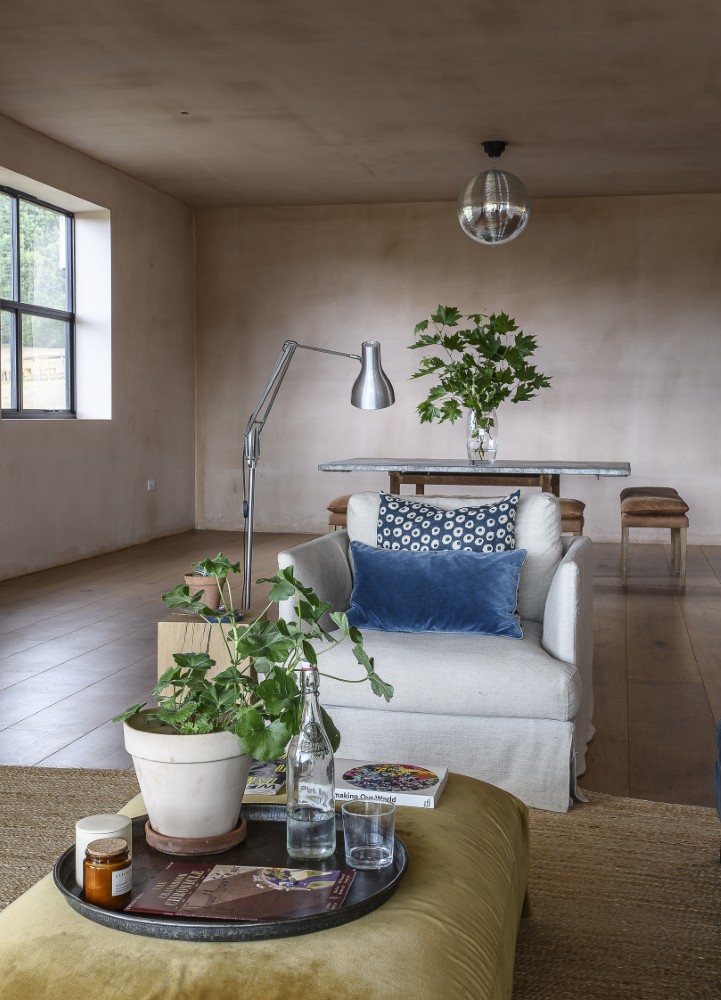
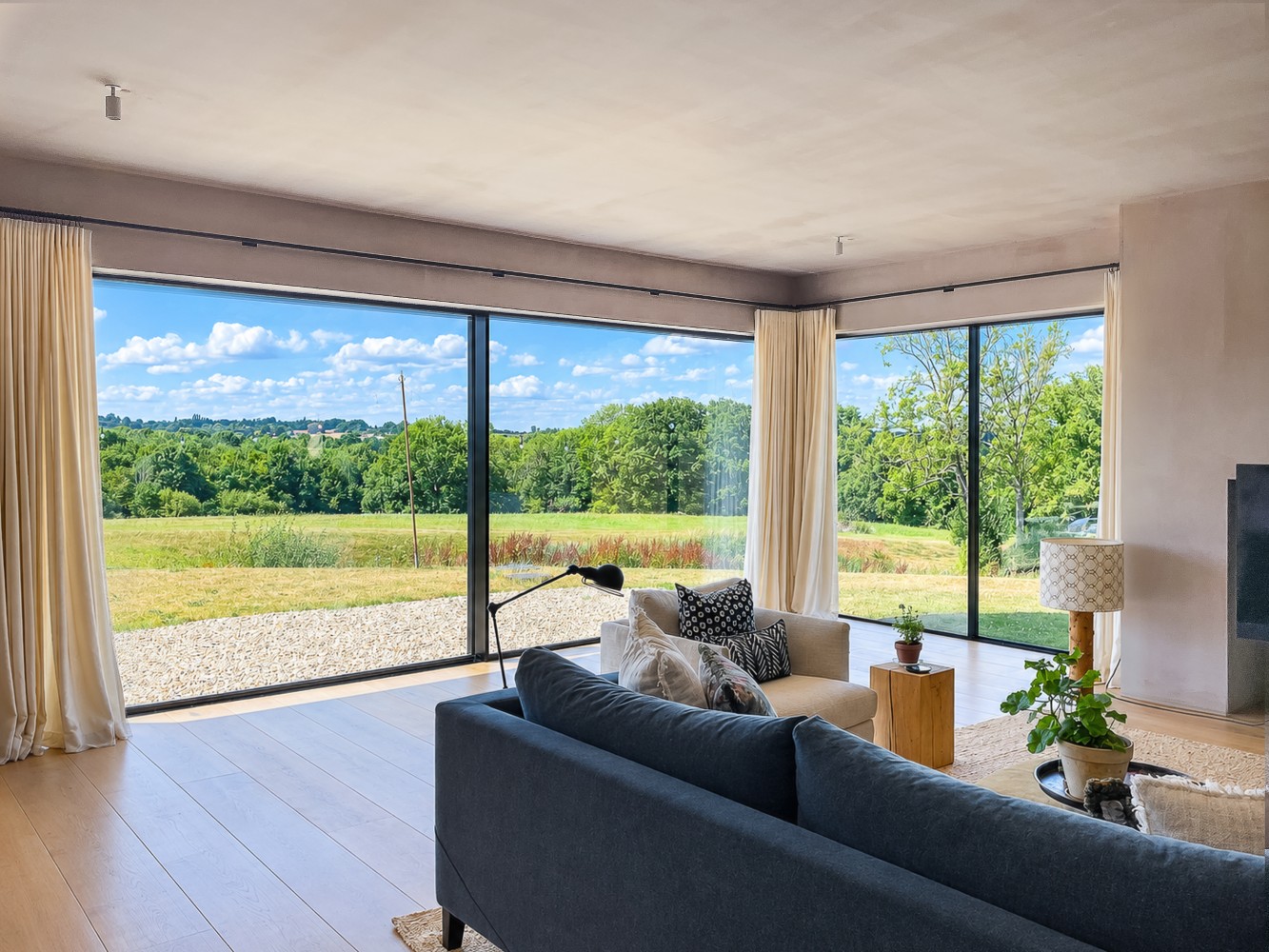
The open kitchen with its concrete worktops flows visually into the dining space and the drawing room, one area opening seamlessly to the next and yet, despite the openness, zoning allows each space to work individually. Large Crittall-style windows connect the rooms with the landscape, while books and records are treated as creative life essentials rather than styling props
That “shed” is rather more impressive than the description suggests. Élise and her family bought the farm in 2015, gradually working their way through its buildings before finally converting the large, cavernous barn – with its sinusoidal tin roof – in 2024. Surrounded by rolling countryside, the agricultural building is enveloped by extraordinary sunrises and sunsets and a sense of escape that Élise had been searching for after a hectic life at the heart of the London contemporary art scene.
But while the barn offered a bucolic location, more importantly, it also offered scale. Élise wanted a building that could bend around different generations of family life, and she also needed it to accommodate her new online and offline gallery concept, Sister Contemporary, with its annual calendar of exhibitions, talks and workshops. The barn is arranged across three levels, with the gallery and studio on the entrance level and the domestic spaces flowing beyond and above it. Huge acoustic museum scale doors can close the gallery away when family life needs to take over, or fold back so the building becomes one continuous, free-flowing space.
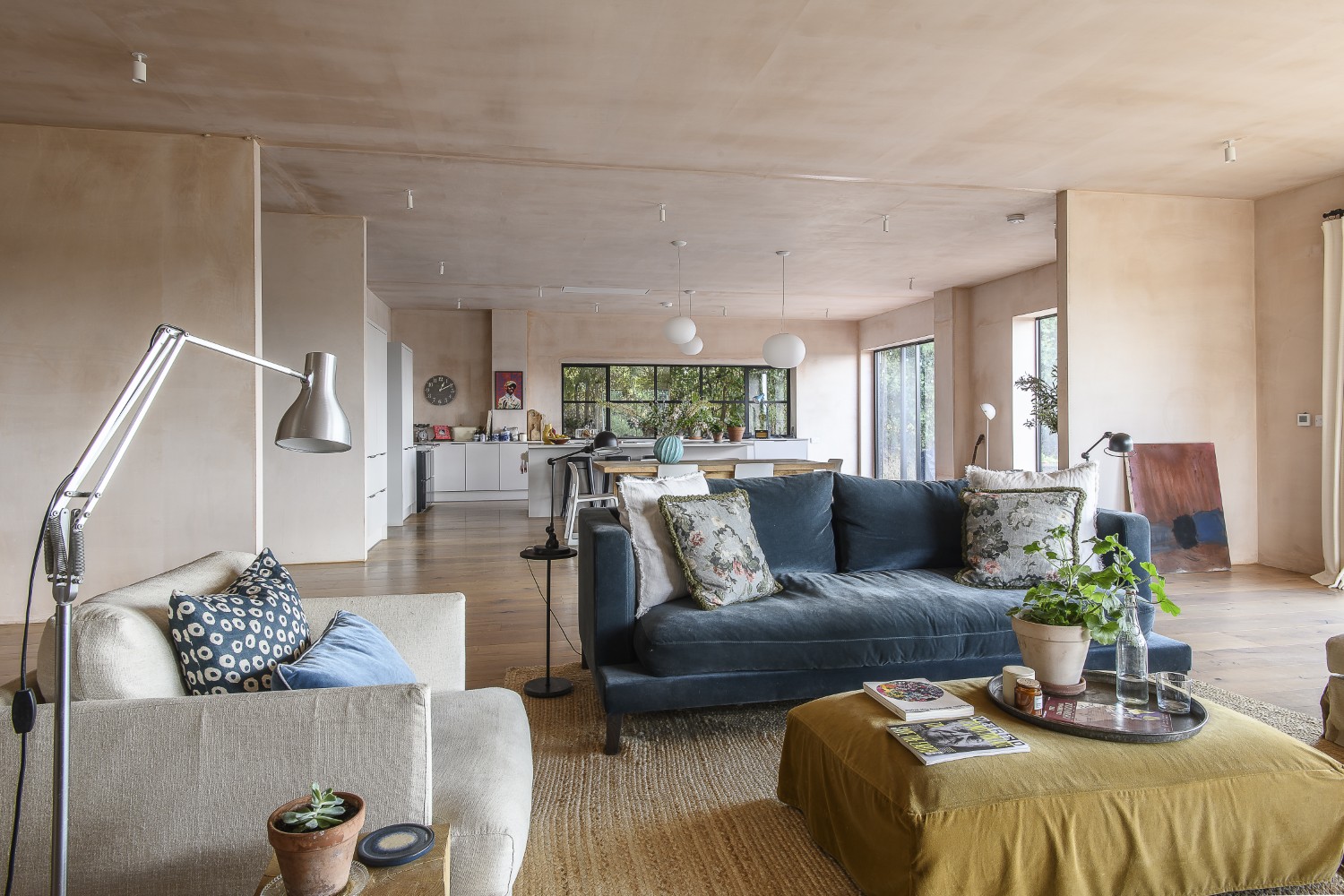
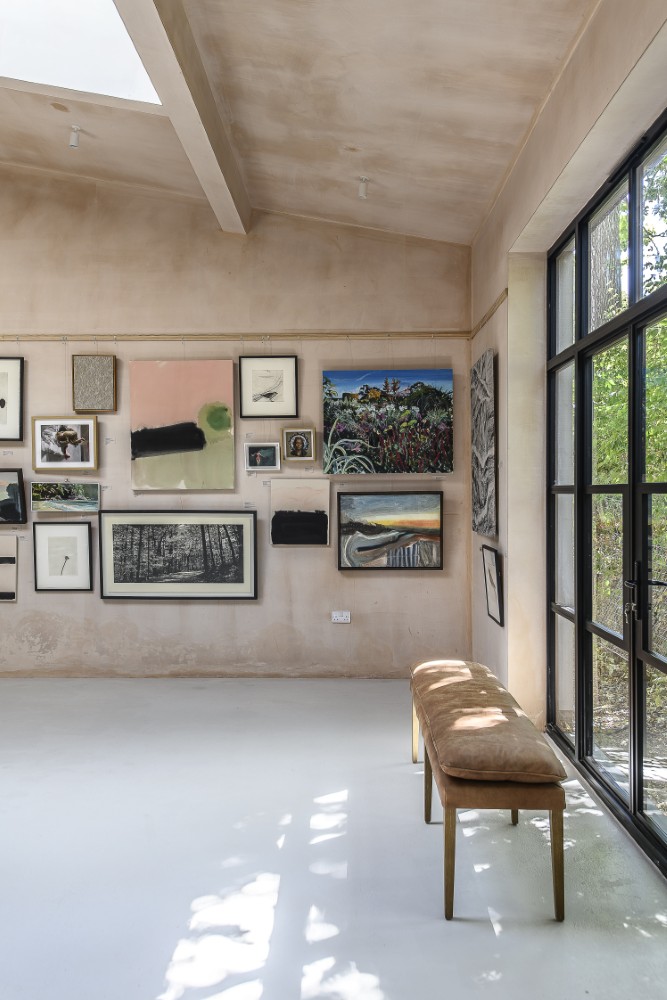
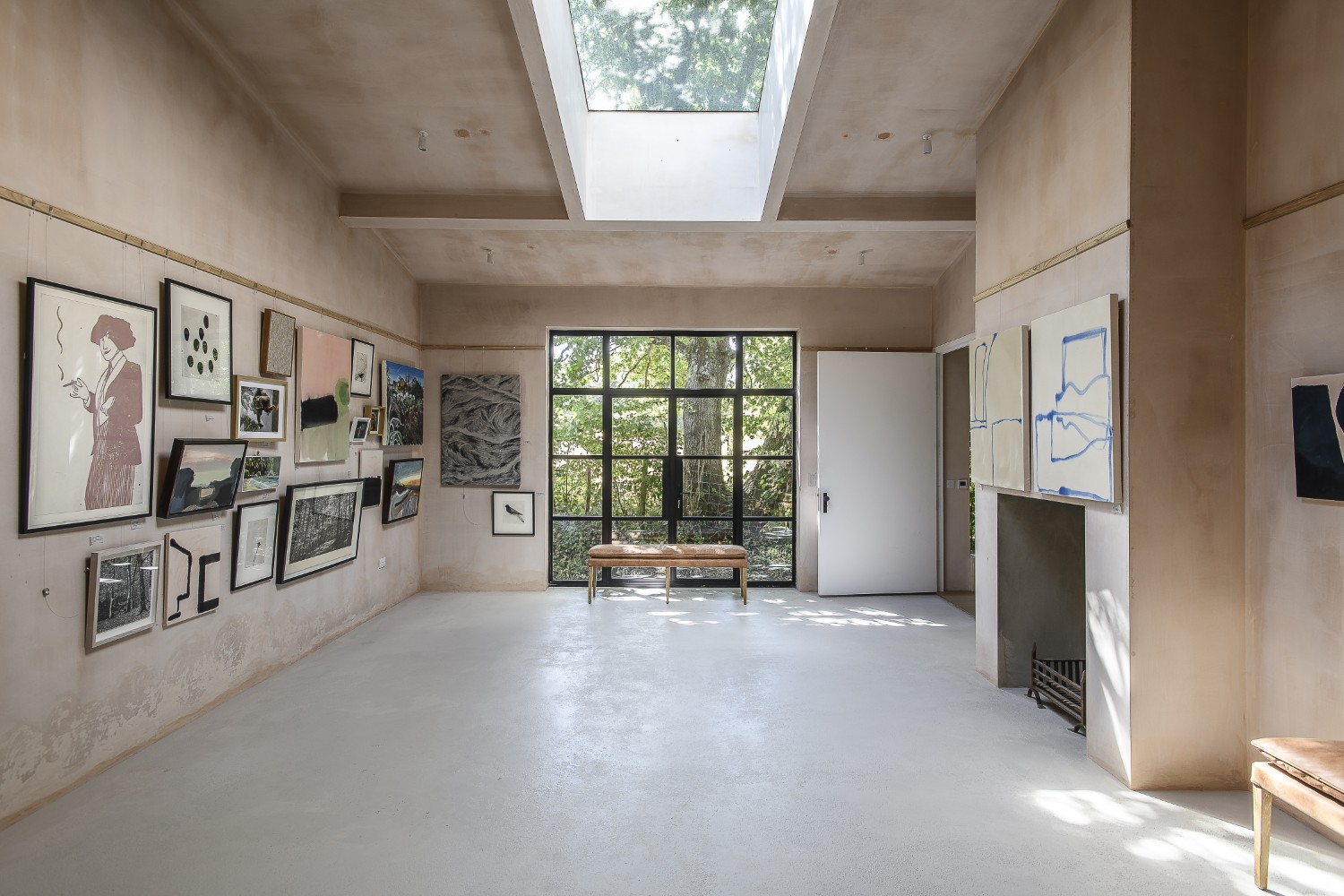
Visually, Élise has resisted the temptation to over-finish. A soft blush of unfinished plaster washes across wide walls that are both structural and floating. Soaring eaves and high ceilings that nod to the building’s past have been left exposed, creating an unexpectedly warm backdrop for a bold and intentional collection of contemporary art that ranges from still life and portraiture to abstraction and landscape.
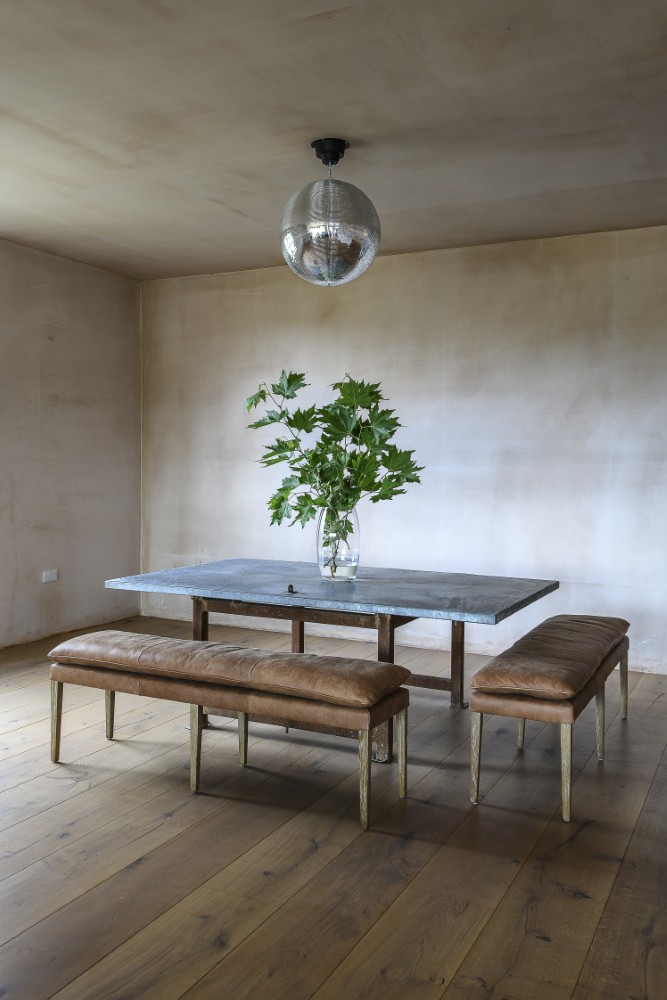
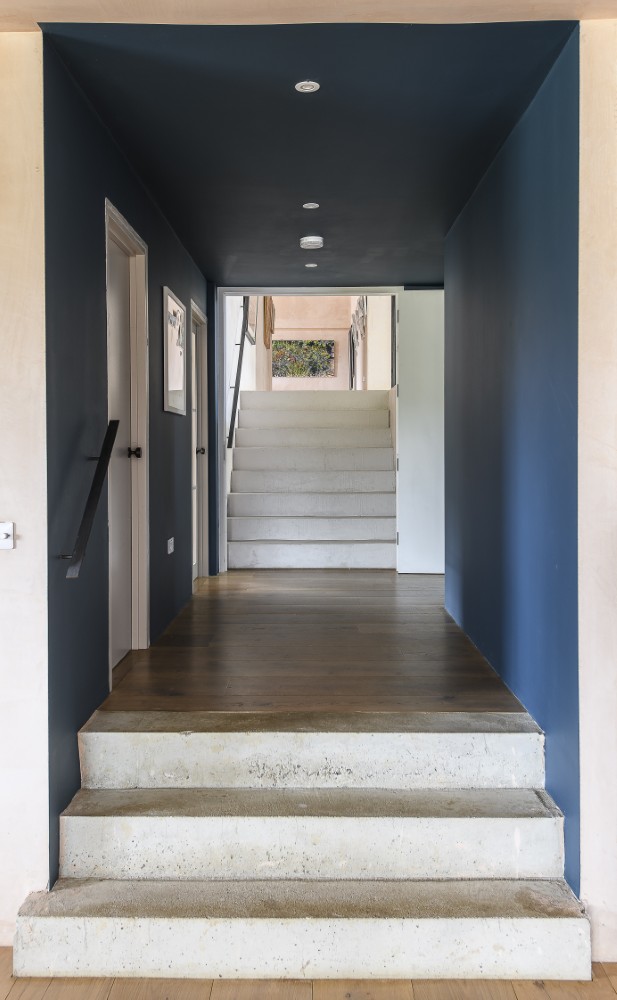
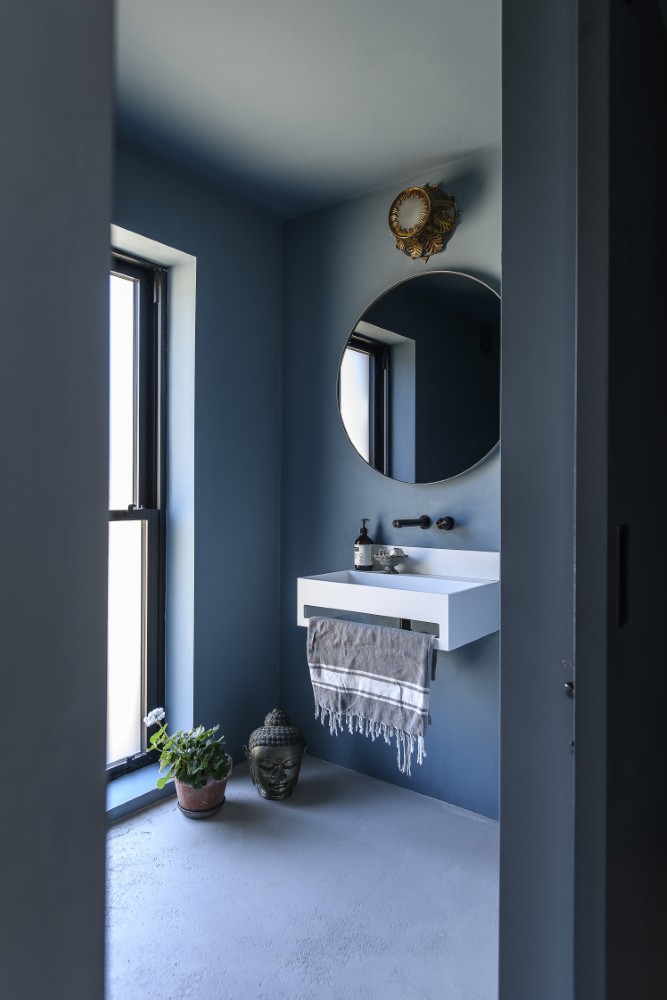
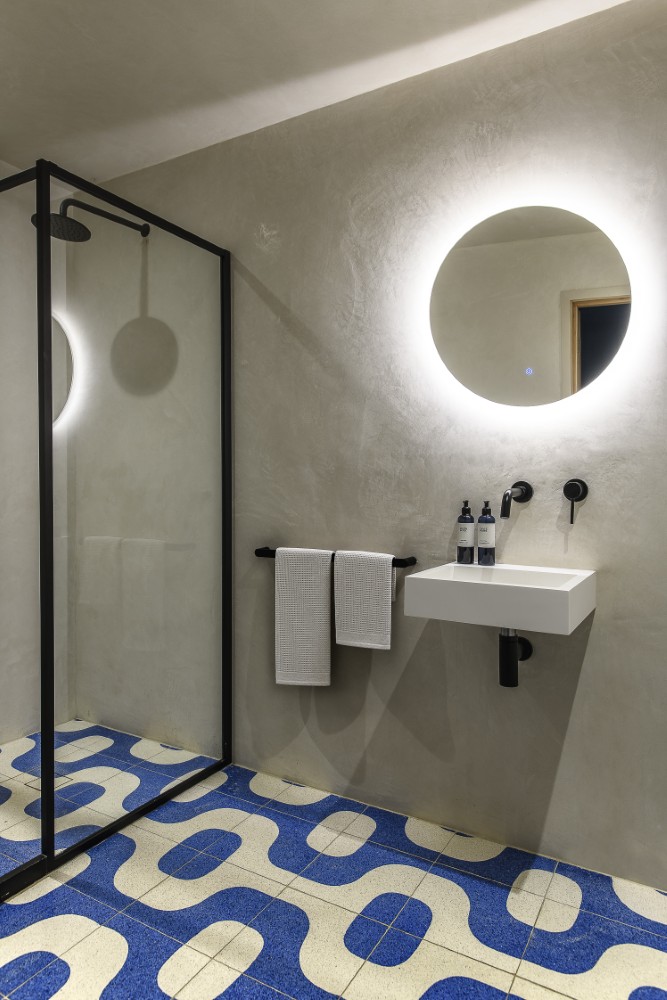
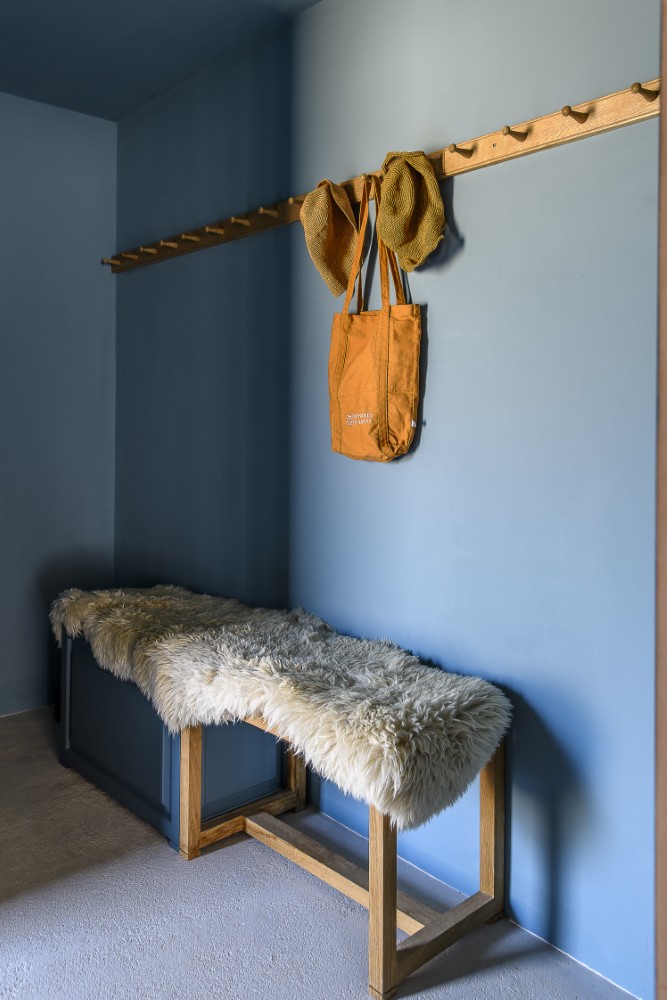
Raw steel and wide British timber floorboards reinforce the building’s almost warehouse-like character, while flashes of deep blue in the transitional spaces, and strategically placed textural vintage rugs and furniture, leather-upholstered benches designed by Élise and the occasional mirror ball, stop the architecture becoming austere. “I wanted to inject soul and warmth,” says Élise. “If you have big wide spaces, they can feel a bit too impersonal, but they are also hives of activity and need context as the users oscillate between function, so the colours and the textures give you a sense of human scale and touch.”
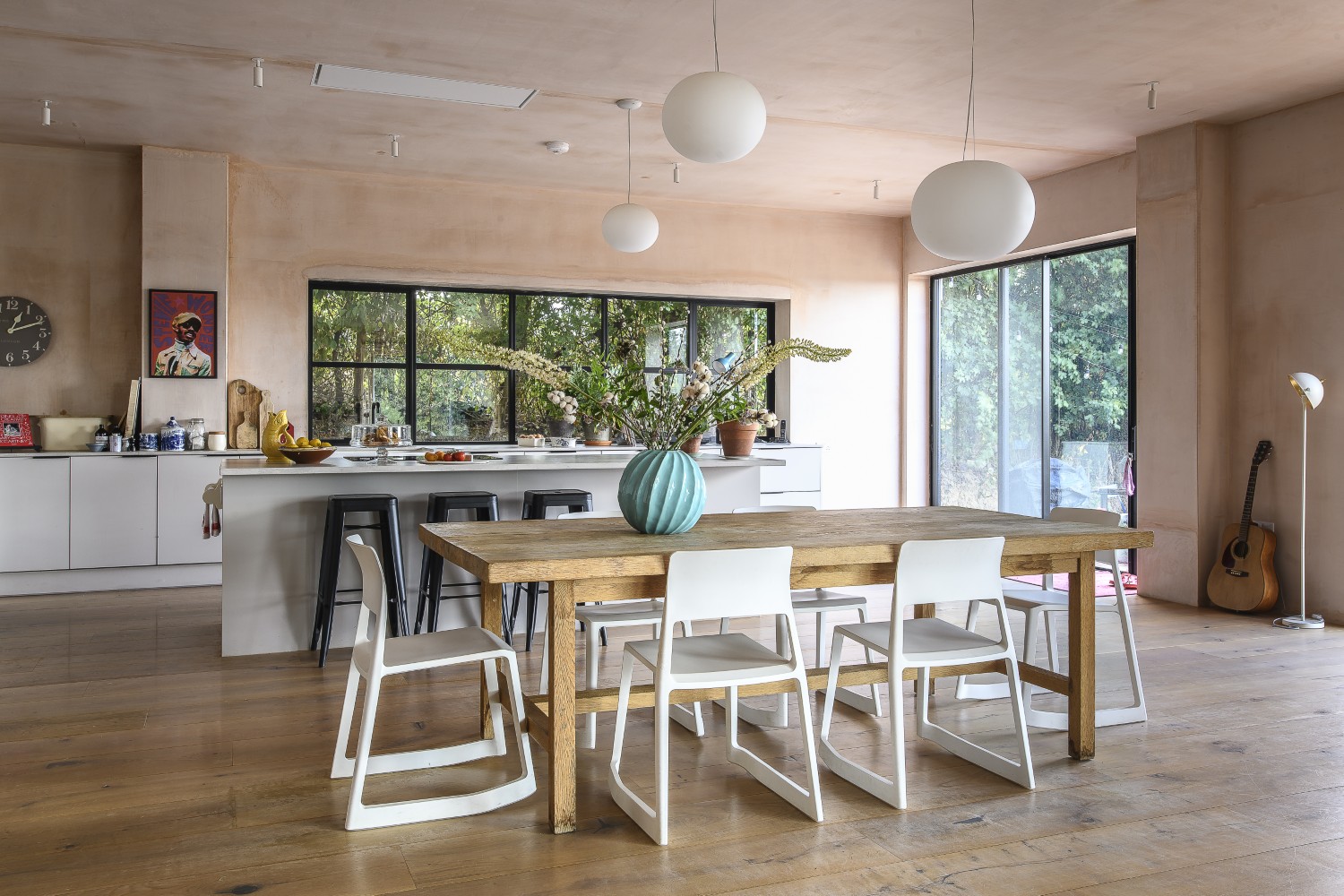
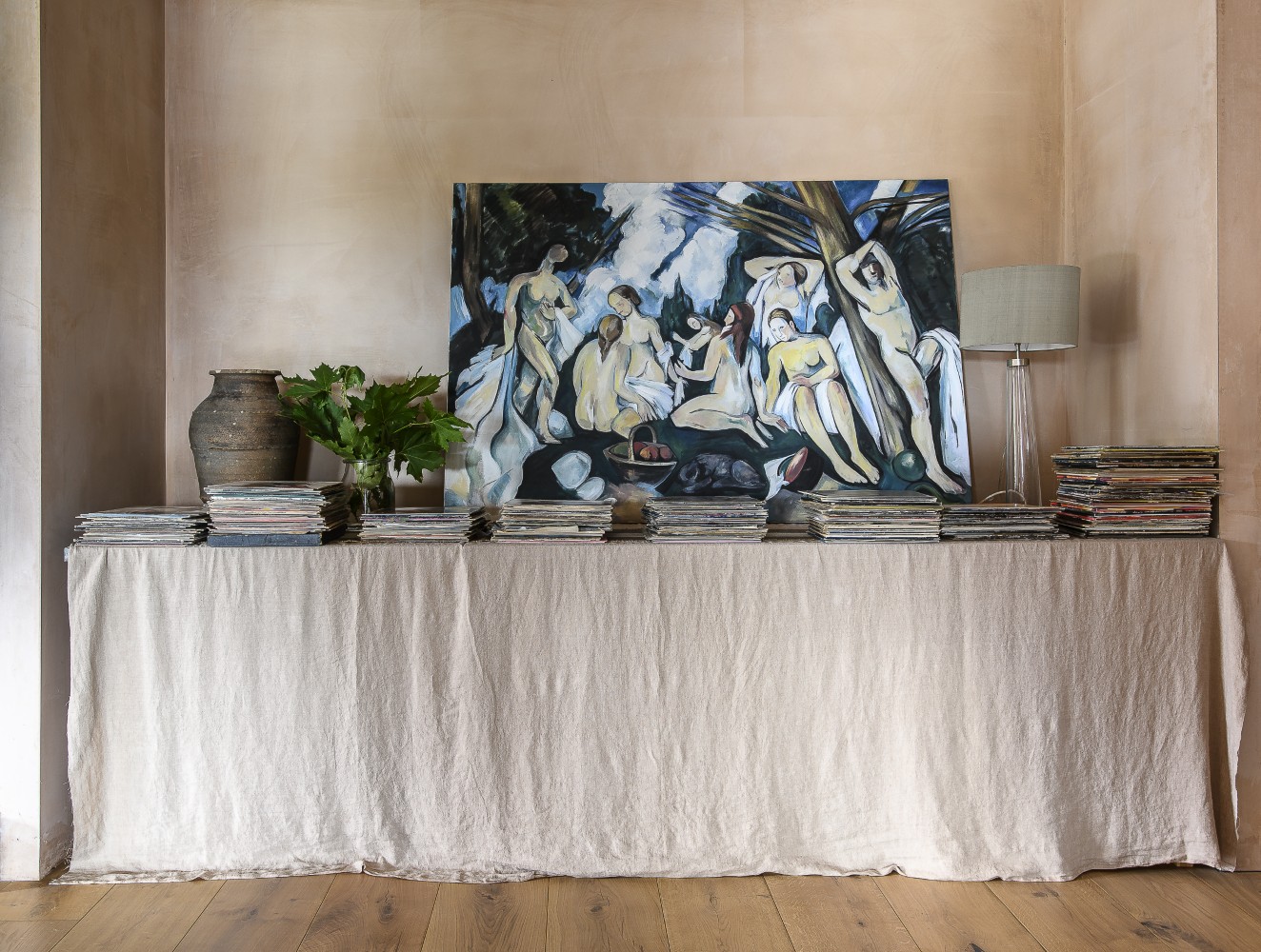
There is a lightness to the way the building is used. In the family’s living area, the open kitchen with its concrete worktops flows visually into the dining space and the drawing room, one area opening seamlessly to the next and yet, despite the openness, zoning allows each space to work individually. Large Crittall-style windows connect the rooms with the landscape, while books and records are treated as creative life essentials rather than styling props. “The priorities have been put in place,” Élise laughs. “We’ve got art, we’ve got books and we’ve got records!”
That combination is central to the atmosphere of Sister Contemporary.
This is not a pristine white cube dropped incongruously into a Kent field, but a gallery mindfully designed to feel inhabited, relaxed and open to different forms of cultural life. Music matters, so does movement. Élise has incorporated several staircases so visitors can make their way around the space by ever varying routes, thus “making the space architecturally salutogenetic”, whilst large works of art can be accommodated without compromise, given room to exist alongside the everyday life of Élise and her family. The building has already hosted children’s workshops, artist demonstrations, yoga and Pilates as well as exhibitions and, one suspects, quite a lot of laughter and dancing.
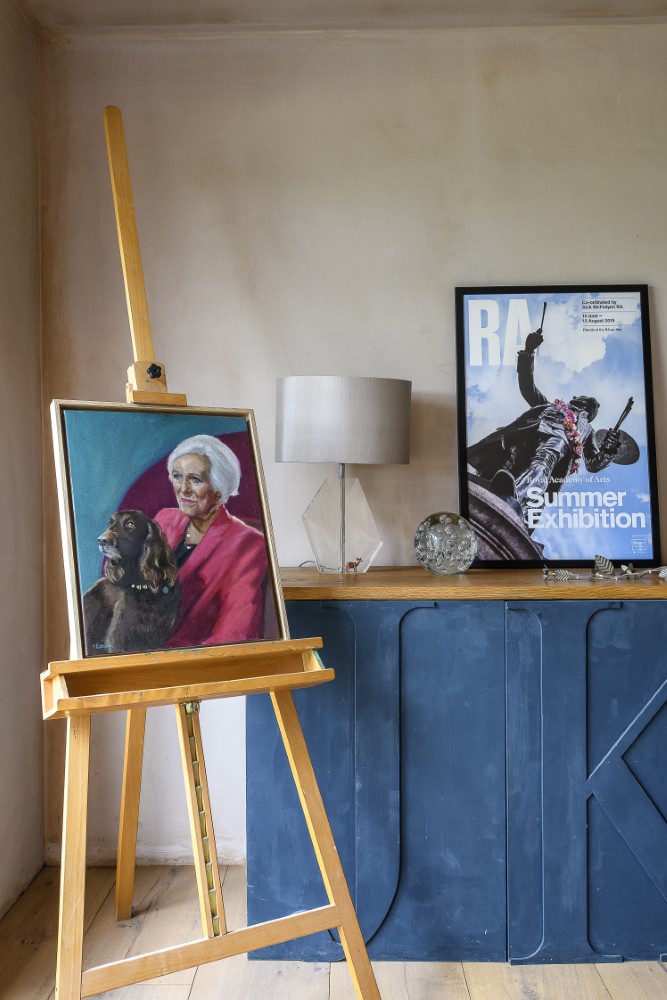
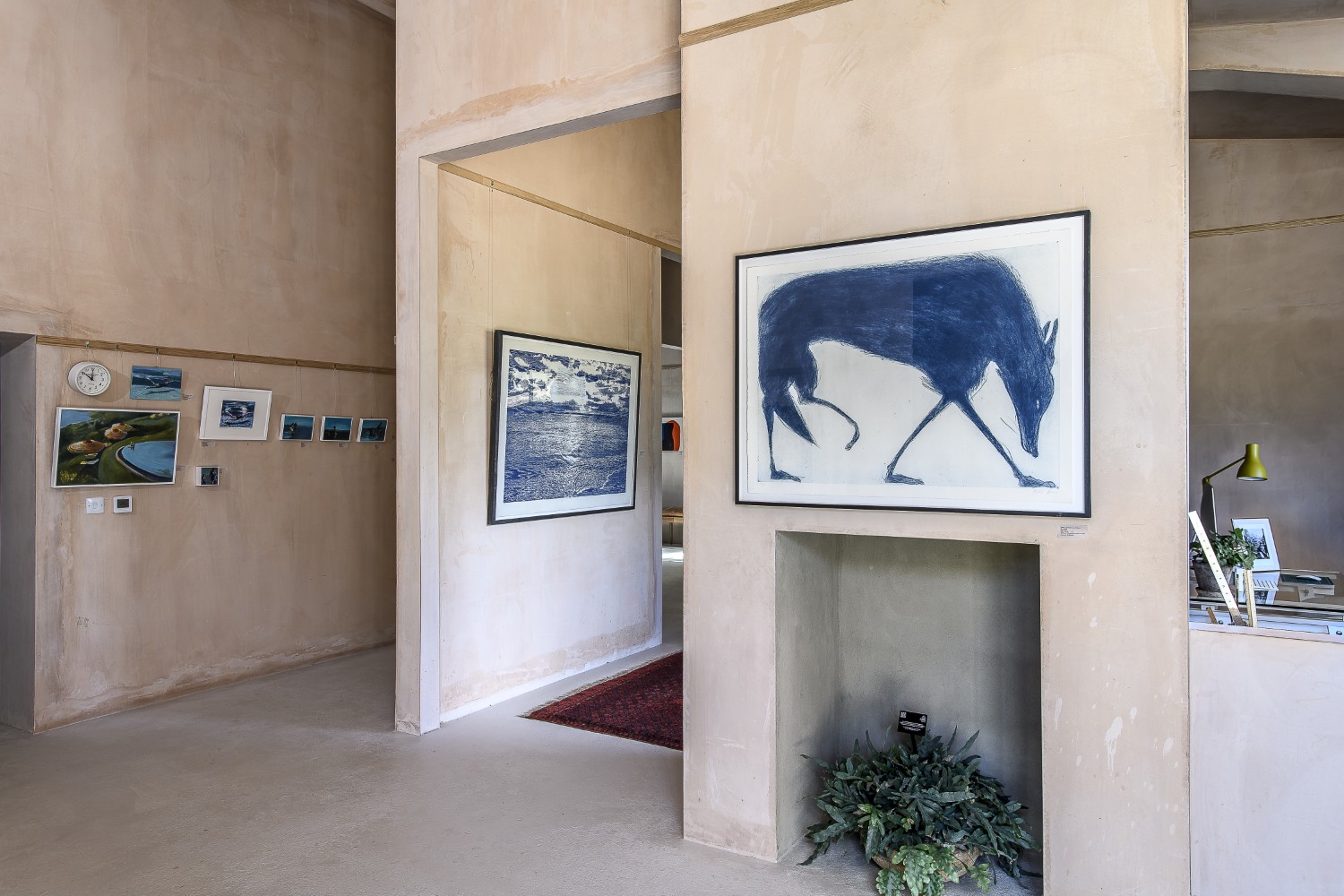
For Sister Contemporary’s first summer exhibition earlier this year, Élise intentionally hung works salon-style, allowing different scales, subjects and price points to sit in lively conversation rather than being separated into neat categories. Some works were positioned lower than a conventional gallery might choose, so that younger visitors or those in wheelchairs could meet them at eye level. It is a small detail, but one that says much about Élise’s approach: accessibility here is not about simplifying the work, it is about removing the small barriers that can make contemporary art feel as though it belongs to somebody else’s life.
For Élise, bringing this kind of contemporary art experience into the countryside is not a diluted alternative to London, but a deliberate act. “I think it’s quite important to have things like this out in the countryside,” she says. “Not everybody wants to go to the coast, and not everybody wants to go into London. It’s also not necessarily economically viable for families, pensioners or students in our current economic climate.” At the gallery’s summer exhibition, local students were among the first visitors through the doors, something she found especially rewarding and the tickets sold for the event raised money for the art department at Cranbrook, the local school her children once attended.
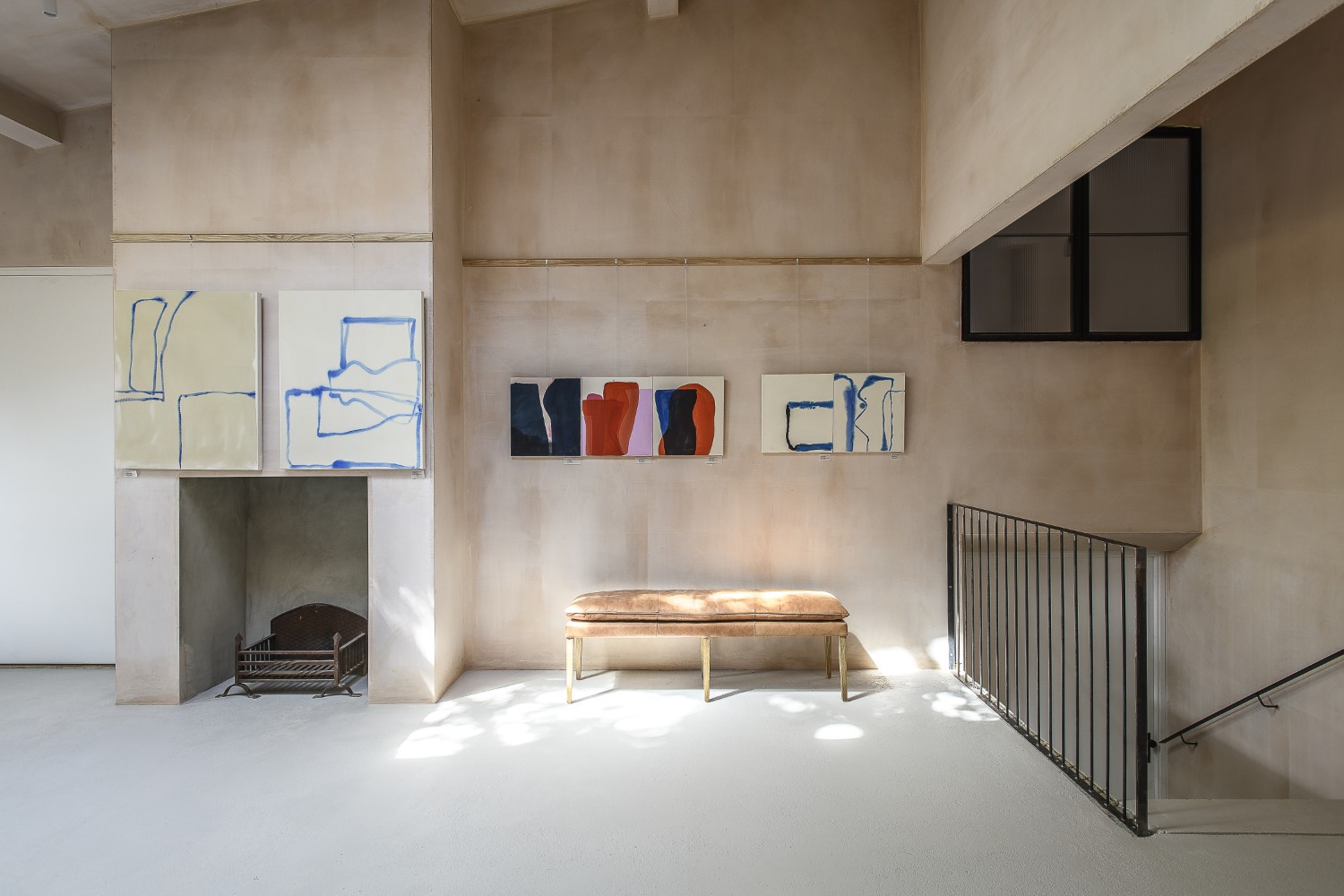
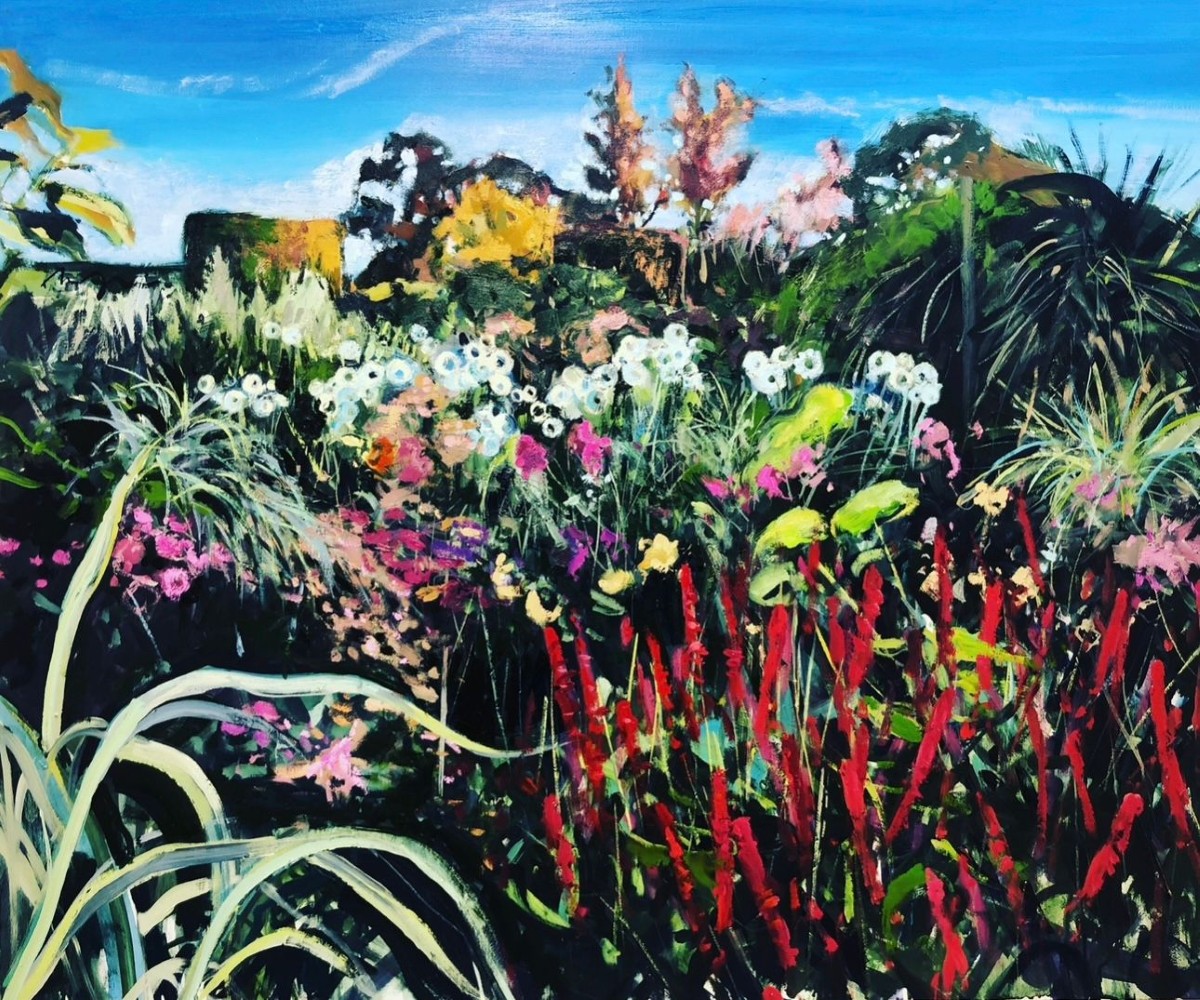
“I really wanted to see children and teenagers enjoying the space. The arts exist for so many good reasons, and there is a body of evidence to justify that the arts are not, nor should ever be exclusively enjoyed by creatives. For children, particularly those who are quite hard wired for STEM, art appreciation or enrichment can help to develop thinking skills, which can make technical people even better at problem solving or innovation. It has always been something we have been brilliant at in the UK and our creative industries can take a lot of credit here.”
Sister Contemporary operates primarily online, with two physical exhibitions a year in Goudhurst, alongside commercial advisory, curation, talks, installation and framing work, and support for clients building their own collections. Élise’s aim is to represent a broad mix of collectible, practising artists, established names alongside emerging talent, with a mission to make collecting feel less intimidating. She is particularly keen that someone spending a few hundred pounds should feel every bit as valued as a collector spending many thousands.
The current roster is deliberately varied. Kate Boxer brings witty, idiosyncratic portraits of literary heroes and fleeting animal subjects; Lisa-Marie Price makes quietly beautiful work from pigments created out of foraged minerals, using salvaged linen and handmade frames leaving minimal footprints; Trevor Price’s printmaking offers a different kind of precision, while Gabriel Langlands’ landscapes are filled with light. Glasgow-based Beth Shapeero brings large-scale abstraction into a part of Kent where commercial gallery spaces rarely have the proportions to show it properly, while Ian Mowforth’s paintings move between gardens, pathways and abstraction often focused on the Kent and Sussex countryside or vignettes of Great Dixter. Vanessa Brassey, meanwhile, brings another dimension altogether: a successful academic and philosopher as well as a painter, whose work circles ideas around the sea, water and the relationship between thinking and making. Vanessa will be in conversation later this year as part of the gallery’s November show. The gallery also represents Paulina Kwietniewska, and Élise is bringing photographer Lorenzo Agius into the gallery for the winter exhibition, showing a selection of some of his iconic work in Kent, in support of the British Heart Foundation, a charity close to both of them.
Painter Ian Mowforth will also be hosting a painting course at Sister Contemporary later this autumn.
Whatever ideas Élise has, she has created a building that is able to meet and house all of it, and that was part of the point of its design. Rather than build a conventional home and squeeze a gallery inside it, Élise thought first about how people move, gather, look and pause. Wide landings and generous staircases become places for conversation; changing vistas allow artworks to appear and disappear as visitors move through the space. Natural light tracks around the building through the day, and its efficient construction is bolstered by strong insulation, air-source heating and underfloor heating throughout. Élise has sourced British materials wherever possible, reflecting her interest in sustainable design practice.
There are other threads running through her working life too. Before Sister Contemporary, Élise co-founded Wonderchup, a health-focused food brand born out of a desire to talk more seriously about sugar and non-communicable disease; the business grew to sell in both the UK and America, while Élise took part in wider food and health policy discussions. More recently her attention has turned to developing alternatives to conventional plastics and tackling microplastic pollution through her new company, Recool. It is characteristic of Élise that the projects look diverse from the outside, but the connecting idea is remarkably consistent: that good design can and should make life better and that business can be used to push worthwhile conversations forward.
There is a personal reason for building life this way too. Élise has a long-standing heart condition, which has made control over her working day less of a luxury and more of a practical necessity. “I have a lot of energy, but there is a limit,” she says. Working from home allows her to manage that energy while still running ambitious projects and being present for her family. The gallery can be closed away behind its acoustic doors, and the kitchen is only steps away; her adult and teenage children and their friends can fill the house without work and home constantly competing with one another.
As autumn approaches, Sister Contemporary is already moving towards its winter exhibition, set for 14 November. Curator Dr Lois Oliver, an old friend from Élise’s V&A days now involved with the gallery, will be in conversation with Vanessa Brassey, opening up exactly the kind of exchange between art, ideas and people that Élise hoped this unusual rural space could make possible. It feels an apt next chapter for a building designed to remain deliberately unfinished in spirit: flexible, evolving, ready for whatever comes next. On one day it is a home, on another a gallery, on another a classroom, a wellness space or a place for gatherings. Mostly, it is all of those things at once. “You can never have too much art in your life, frankly, it is the key to freedom and fulfilment.’”
Address Book:
Find out more about the programme of events, workshops and exhibitions at sistercontemporary.com
- words: Antonia Deeson
- pictures: David Merewether
- location: Nr Goudhurst
You may also like
Letting the House Lead
Hidden within its own private grounds on the historic Highfields Estate, Blackham Court Farmhouse offers a serene escape, enveloped by the beauty and tranquillity of the Sussex countryside For a few years now, there has been a quiet shift in...
Collected at the Oast
Room by room, year by year, artist Sarah Featherstone and her family have poured their creativity into the renovation of a large oast, transforming it not only into a family home, but a wonderful venue in which to display Sarah’s...
Finally Home
With a refined eye for art and furniture, journalist Patrick McAleenan has spent the last few years curating the interior of his St Leonards home with carefully chosen pieces, prompting his latest venture, South Coast Stories, a PR platform for...