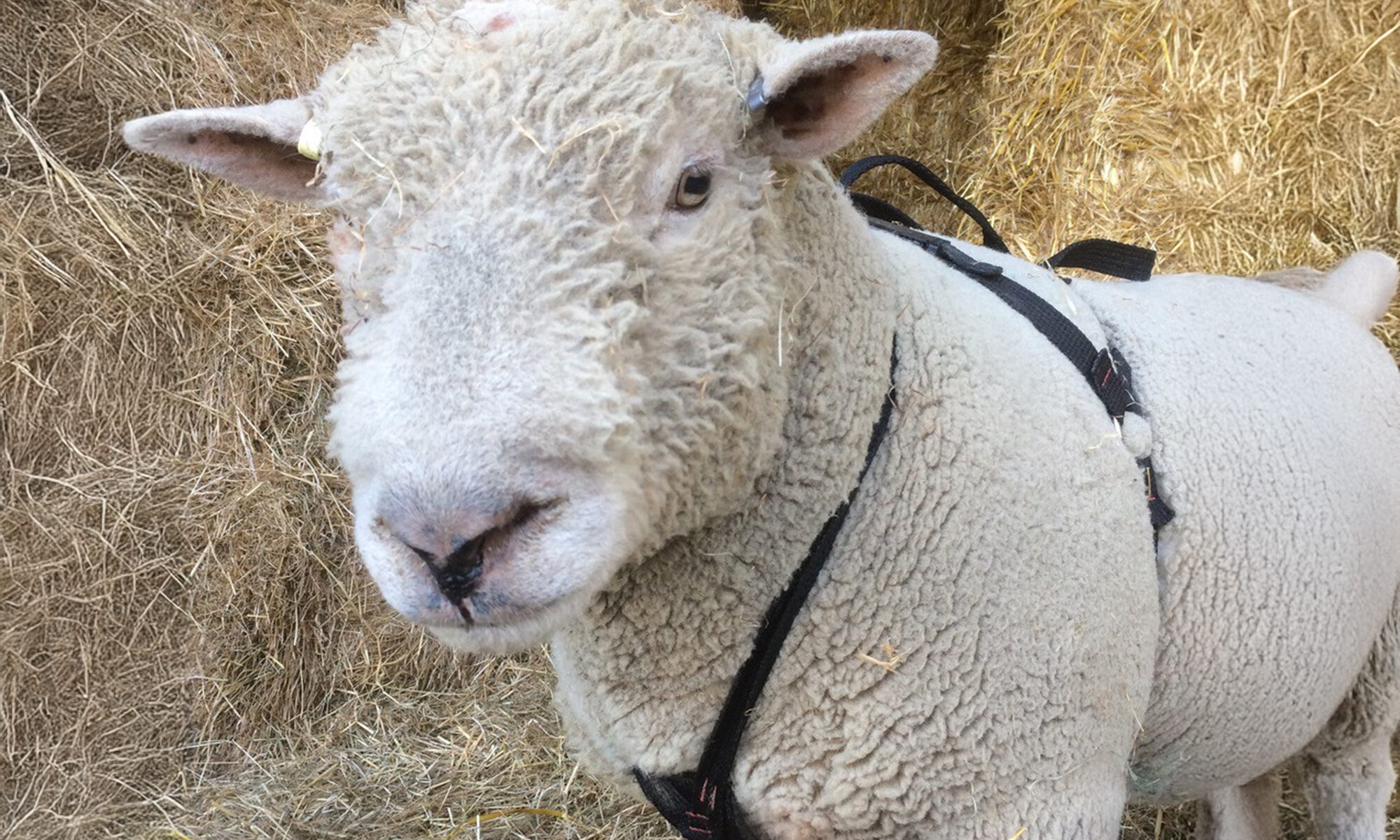
Jane checks the condition of her flock to ensure next year’s lambs are happy and healthy
At the end of October we put the rams in with the ewes and there we shall leave them for about four weeks. Female sheep – ewes – are only fertile when the night time hours exceed the daytime hours which is nature’s way of making sure lambs get born in the spring when the weather is getting warmer and the grass starts growing.
A ram can service about 30 sheep at a time and so we have put two Texel rams – a stout muscular Dutch breed – in with some sixty Southdown cross ewes. The Southdown breed, as its name suggests, is native to the South Downs and while not as muscular as a Texel it has more threads of fat in the muscle so is much tastier. The cross between the two creates a great combination of both attributes – a meaty, tasty lamb.
Before we breed from them we have to check the ewes to make sure they are fit enough to support another pregnancy which involves checking their teeth, toes and teats. Typically a ewe will have her first lambs at two and go on to have another four or five pregnancies. What usually lets them down is their teeth. Ewes with worn or missing teeth, known as broken mouthed, struggle to graze and maintain body condition and so they are culled.
As do those with lumpy teats which is an indication of mastitis which will stop milk production the following spring. And finally we need to check that they are still sound and mobile – bad feet and arthritis can lead to lameness and if they can’t move around they won’t graze well, milk well or produce healthy fat lambs.
Before a ram is introduced, he’s fitted with a harness, a raddle, that holds a coloured wax crayon between his front legs which leaves a big mark on the ewe’s rump when she’s been serviced
We have already selected the replacement “tegs”, young sexually mature female sheep, born spring 2024, that have not yet seen the ram. They are added to the flock to make up for the old girls being moved on and so maintain flock numbers.
Before a ram is introduced, he’s fitted with a harness, a raddle, that holds a coloured wax crayon between his front legs which leaves a big mark on the ewe’s rump when she’s been serviced. Once he’s suited and booted we’re ready to go. Signs that a ewe is in season include tail wagging, restlessness and she’ll actively seek out a ram and stand still for him to mount her. For his part he mainly relies on a sense of smell. On the roof of his mouth is a special organ and following a good sniff he’ll curl his upper lip to create a flow of air over it so he can accurately assess whether she’s in “standing” heat. This is called the Flehman effect.
Ewes will come into season about every 18 days, so with 60 in the flock we would expect a good 30 to have coloured bottoms after ten days. At that point we’ll change the colour to green so that, come next March, we will bring the orange ones in to lamb first, before the greens, allowing more room in the lambing shed than if we had to bring them all in together.
At the end of the month we’ll remove the rams so that next spring after four weeks of sleepless nights we’ll know it will all soon be over. But right now it’s a time of expectation and the start of another sheep year. Exciting.
You may also like

What the fascia?!!
Sarah Maxwell shines a light on the hidden web of connective tissue that holds your body together and keeps it moving Think of fascia as your body’s soft, stretchy wrapping – a type of connective tissue that surrounds and connects...

Small changes big results
Nutrition & Lifestyle Coach Charlotte Lau explores how to help you find your winter rhythm this November November brings shorter days, colder mornings and a natural shift towards spending more time indoors. With the festive season approaching, it can also...
Small changes big results
Nutrition & Lifestyle Coach Charlotte Lau explains how to build your autumn resilience October is when autumn really begins to settle in. The days are shorter, temperatures drop, and our routines naturally start to move indoors. It can be tempting to...